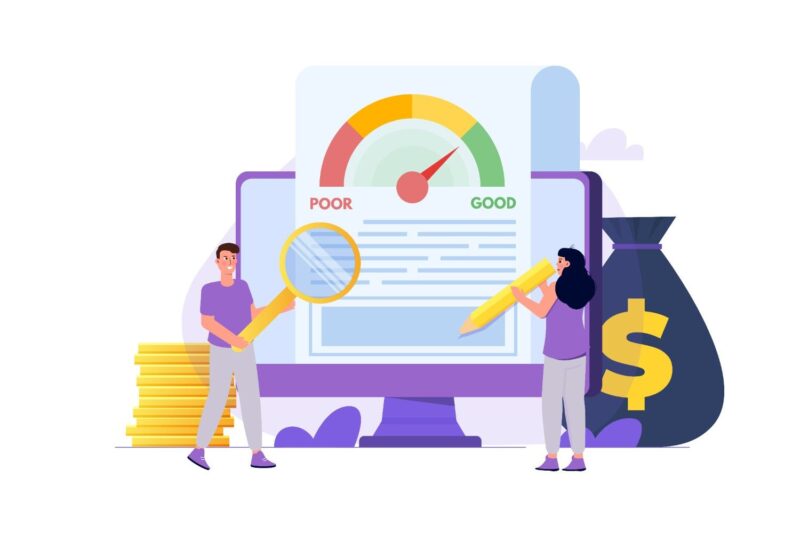

Many people believe that their salary directly increases or decreases their credit score. You might have also heard someone say, “Earn more money and your credit score will rise.” This idea is very common, but it is not completely true. Today, we will understand the role of income in credit score, what actually counts, and what does not.
This guide will explain the facts in simple language. So that it will be easy to understand.
What Is a Credit Score?
A credit score is an indicator of one’s creditworthiness expressed by a number ranging from 300 to 900. It reflects the borrower’s loan, EMI, and repayment handling capacity.
Using a Credit score, banks determine whether an individual can be qualified for,
- Personal loans
- Credit cards
- Home loans
- Business loans
A high score implies,
- quicker approval
- reduced interest rate
- larger loan amount
Does Income Count in Credit Score Calculation?
Initially, one must understand that salary or business income is not directly included in the calculation of a credit score.
Credit bureaus never consider,
- Your job position
- Your company
- Your salary
- Your business income
But, credit bureaus verify,
- How do you give money back
- How you use your credit card
- Your previous EMIs
- Any late or pending payments
That is the reason why a person with a ₹25,000 monthly income can have a higher score than a person with a ₹80,000 monthly income.
So, where does income matter? Let’s understand this deeper.
The Real Role of Income in Credit Score
Credit bureaus do not just increase a credit score for the earning person. The income factor in a credit score is only seen indirectly.
Here is how,
1. Higher Income Makes It Possible to Pay EMIs on Time
You would not have any difficulty paying the EMI if your income is good enough. Your score will improve if you repay the loan on time.
2. Higher Income Keeps One from Using a Credit Card More Than the Limit
A well-paid person is likely to pay off the credit card completely each month. This results in low credit card usage.
3. Higher Income Means Less Financial Stress
Missing an EMI is almost impossible when the financial pressure is low.
So, the role of income on credit score is indirect and supportive.
Myths About Income And Credit Score
Many wrong misunderstandings exist. So let’s make it clear.
Myth 1 – A high salary alone builds a high score
But we need to understand the fact that salary is not recorded in the score at all
Myth 2 – A student cannot build a good credit score
But the fact is, if a student has a credit card or EMI loans and if he/she make the repayments properly, they can build a credit score of 750+
Myth 3 – A Higher score means a higher income
But the real fact is credit score only shows the repayment behaviour.
This is another proof that proves again that the role of income in credit score is limited.
Where Income Actually Matters
Although income does not affect the score calculation, banks still take it into account for loan approval.
Banks verify income,
- to decide the loan amount
- to determine the EMI capacity
- to fix the loan tenure
- to approve or reject the loan application
So this is the income-based loan approval part and not the score calculation part.
Banks may require,
- salary slips
- bank statements
- Income Tax Returns
- GST returns
- business proofs
This helps to guarantee that the EMI is within the customer’s affordability range.
Areas Where Income is Not a Factor
Income is not used for the calculation of
- credit score value
- credit ranking
- repayment history score
- card repayment score
A person who has just changed jobs or lost their income will still have the same score-unless they start missing payments.
What Leads To The Misconception That Income Affects Score?
Because banks tend to easily approve loans for high-income earners.
This is the reason for the confusion.
Let’s take an example,
| Customer | Salary | Score | Bank Response |
| A | ₹30,000 | 820 | Approved |
| B | ₹78,000 | 620 | Rejected |
This example is enough to prove that income alone cannot help. Again, the role of income in credit score is supportive.
How Your Financial Habits Affect Your Credit Score More Than Salary
The main factors that determine a credit score are as follows,
1. Timely Payments
Missing one EMI can suddenly drop your score.
2. Credit Card Utilisation
Using over 40% of your credit limit frequently will decrease your score.
3. Multiple Loan Enquiries
A high number of loan applications will lower your score.
4. Long Credit History
Having old credit accounts will help you score higher.
None of these depend on income directly. So the role of income in credit score is only related to repayment capacity.
Why Do Banks Continue to Inquire About Your Income During the Loan Process?
Because they want to avoid payment risk.
The banks’ decision-making process includes the following,
- Whether you can afford the EMI
- The ratio of EMI to your income is not higher than the limit
- You can repay without delays
This is why banks check for financial stability and repayment, thus helping them to predict your ability to repay.
Common Mistakes People Make
The following are the mistakes people usually commit when they misunderstand the effect of income
- Thinking that an increase in salary automatically scores
- Not paying off the full amount on credit cards
- Borrowing several small loans
- Closing long-term loan accounts
- Applying for loans even when not necessary
Being aware of these will definitely contribute to your score more than the salary increase.
So, What Is the Right Area to Focus On?
The process is super simple,
- Always pay the entire amount due on your credit card rather than the minimum
- Keep the usage of your total credit lower than 40%
- Restrict the number of loan applications
- Make sure you use your old credit accounts regularly
- Read your credit report each month
Your income can’t do much for your credit score, but your character can.
So, once again, we can conclude that the role of income in credit score equals supporting, not scoring.
Conclusion
Your income does not directly go into your credit score calculation. However, it affects repayment behaviour, and repayment behaviour affects the score. So earning more does not automatically improve your score, but paying EMIs on time definitely does. Focus on timely payments, low utilisation, and fewer loan applications. These matter more than salary when it comes to maintaining a strong score.